B$S THE DEVOTIONAL WORK
Kṛṣṇa with flute and black bird, blue skin lit by fractured gold
01 / THE FLUTE CALLS THE VISION CYCLE

TOM MOSS · BLUE $NAKE STUDIO

The fruit of my bhakti.

Kṛṣṇapakṣi

The Black Bird of the Shadow-Path

The black bird wears the prayer.
The shadow-path carries the Names.

▶ Enter the crossing-song ↗

THE RECORDING · THE VISIONS · THE COMPLETE WORK

A black wing. A hidden name. Discover the work ↓
THE OFFERING ↓
01 / THE OFFERING

Everything gathered.
Everything offered.

Kṛṣṇapakṣi is the fruit of bhakti: a crossing-song in which the Holy Names are carried within the poetic form of the black bird and the shadow-path.

Tom Moss offers the work in the conviction that the Holy Name is deliverance in this age of Kali. The Mahā-mantra is encountered three times: in the opening name-elements, in the audible chant, and in the syllable chart, alongside the Pañca-tattva prayer. Devotion is its source.

“I came to take the fruit away.
I stayed to tend the tree today.”

FROM DISCOVERY TO DEVOTION
02 / LISTEN

THE RECORDING

Let the Names
carry you.

Listen first. Let the words open afterwards.

THE LIVING CHANT
THE CROSSING-SONG80 TIMED LINES

THE FRUIT OF BHAKTI

Kṛṣṇapakṣi

Press play. Follow the Names.

UP NEXT

THE ENGLISH WINDOW

Follows the voice.

Kṛṣṇapakṣi0:00 / 3:46
Take Me Over (Remix) · supplied recording
Timing +0.0s

Follows the sung order of the remix. Tap any translation to return to that line.
The sixteen-movement reader remains below.

03 / THE VISION CYCLEContinue to the song ↓

MIDNIGHT BLUE / WEATHERED GOLD

Ten visions.
One crossing.

04 / THE CROSSING-SONG

SIXTEEN MOVEMENTS

From the shadow-path
to the crossing.

The original chant and the devotional English reading, preserved from the supplied reader edition.

I

Opening Verses

Hareśa-chāyā-mārge

hareśa-chāyā-mārge antare bhāvaha,
kṛṣṇapakṣi-śakune habe pāra
hare-nātha antar-jyoti naḥ pracodaya,
kṛṣṇa-gaura uha sāra

On the shadow-path of Lord Hari, within the heart, feeling awakens.
Through the omen of the black/Kṛṣṇa bird, one may cross the ocean.
O Lord Hare, awaken our inner light.
Kṛṣṇa and Gaura — this is the essence.

II

The Black Birds Dream

Kṛṣṇapakṣi-svapna

kṛṣṇa-pakṣiṇaḥ svapnaṃ paśyanti punaḥ punaḥ,
kṛṣṇa-pakṣā mārga-darśakāḥ
hare-jñāna udeti yāvat svapnaṃ hṛdi sphure,
hare-dhvani vahati śakunāḥ

The black birds dream again and again.
The dark wings become guides upon the path.
Hare-knowledge rises while the dream shines in the heart.
The omens carry the sound of Hare.

III

Gaura & the Pañca-tattva

Gaura-tattva

hare-gaura-chāyā nitya-vāyau līyate,
rāma-rase advaita-sparśaḥ
hare-gadādhara-dhvaniḥ hṛdaye śrūyate,
rāma-jyotiḥ śrīvāsa-pakṣaḥ

The golden shadow of Gaura dissolves into the eternal wind.
In the nectar of Rāma, Advaita's touch is felt.
The sound of Gadādhara is heard within the heart.
Rāma's light becomes the wing of Śrīvāsa.

IV

The Guru's Resonance

Guru-nāda

rāma-nāde guru-nādaḥ sphurati,
rāma-hāre prema ujjvāla
hareṇa pareṇa dhareṇa hara,
hare kṛṣṇa hṛdaya-vihāra

In the sound of Rāma, the sound of the guru flashes forth.
In Rāma-Hare, love burns bright.
By Hare, beyond, through the earth, let all be carried away.
Hare Kṛṣṇa wanders and plays within the heart.

V

Remembrance

Smaraṇa

gauraṃ nityānandaṃ advaitaṃ smarāmi,
gadādharaṃ śrīvāsaṃ ca
antar-hṛdaye bhāvayāmi sadā,
kṛṣṇapakṣiḥ nayatu māṃ

I remember Gaura, Nityānanda, and Advaita.
I remember Gadādhara and Śrīvāsa too.
Within the inner heart I meditate always.
May the black/Kṛṣṇa bird lead me onward.

VI

The Mahā-mantra

Mahā-mantra

hare kṛṣṇa hare kṛṣṇa,
kṛṣṇa kṛṣṇa hare hare
hare rāma hare rāma,
rāma rāma hare hare

Hare Kṛṣṇa, Hare Kṛṣṇa,
Kṛṣṇa Kṛṣṇa, Hare Hare.
Hare Rāma, Hare Rāma,
Rāma Rāma, Hare Hare.

VII

The Chant Carries the Omen

Śakuna-vāhana

kṛṣṇa-hari-nāma antare me,
chāyā-mārge hari-rasa sphura re
gaura re nityānanda-vaha,
hṛdaye antare śakunaṃ tu vaha
pakṣi-kṛṣṇa chāyā-mārga re,
mama hṛdaye rāma-nāma sphura re
śrī-kṛṣṇa gaura-jyoti iha,
rasa-dhārāsu madhye śakunaṃ vaha
gaura-hari chāyāsu kṛṣṇapakṣi-nāma,
o hare śuna re rāma

The name of Kṛṣṇa-Hari is within me.
On the shadow-path, the nectar of Hari begins to shine.
O Gaura, carrier of Nityānanda,
carry the omen deep within the heart.
O dark/Kṛṣṇa bird on the shadow-path,
let the name of Rāma shine within my heart.
Here is Śrī Kṛṣṇa, the golden light of Gaura.
Among the streams of nectar, carry the omen.
O Gaura-Hari, among the shadows is the name of the black bird.
O Hare, listen — O Rāma.

VIII

At the Lotus Feet

Pada-mūla

hari re gaura-guru śrī-kṛṣṇa,
pada-mūle re cittaṃ sadā dhārā
jaya kṛṣṇa-nāma śrī-kṛṣṇapakṣi,
hṛdaye rāsa sphura mahima
śrī-kṛṣṇa-gaura-hari śrī-kṛṣṇa,
caitanya-nāma me hṛdaye dhārā

O Hari, O Gaura-Guru, O Śrī Kṛṣṇa,
at Your lotus feet my mind forever flows.
Victory to the name of Kṛṣṇa, victory to the sacred black/Kṛṣṇa bird.
In the heart, the rasa shines with glory.
Śrī Kṛṣṇa, Gaura-Hari, Śrī Kṛṣṇa —
the name of Caitanya flows within my heart.

IX

Black Birds, Black Butterflies

Kṛṣṇa-balambala

kṛṣṇāḥ pakṣiṇaḥ svapnanti
kṛṣṇān balambalān iva;
teṣāṃ svapne punaḥ sphuranti
kṛṣṇāḥ pakṣiṇa eva hi.

The black birds dream
as if they were black butterflies.
Within their dream, again they shine forth
as black birds once more.

X

The Folded Wing

Pakṣa-saṃhṛta

he narāḥ, paśyata pakṣaṃ saṃhṛtam;
śakunaḥ draṣṭāraṃ svapnati,
draṣṭā śakunaṃ svapnati;
bhayaṃ ca dhārayati rūpam
eka-pārśvasya cakrasya.

O people, behold the folded wing.
The omen dreams the seer,
and the seer dreams the omen.
Fear itself takes the shape
of a circle with one side.

XI

The Boat Beyond the Demon's House

Nāvā-tāraṇa

he balakāḥ, ākarṣata, ākarṣata —
agninā, phenena ca;
imaṃ nāvaṃ nayāmaḥ
asurasya gṛhāt param.

O boys, pull, pull —
by fire and by foam.
We carry this boat
beyond the house of the demon.

XII

Where the Angels Hide

Devadūta-nilaya

he kanyāḥ, ākarṣata, ākarṣata —
stanitena, gagane ca;
dvārāṇi bhanjāmaḥ
yatra devadūtāḥ nilīyante.

O girls, pull, pull —
by thunder and through the sky.
We break the doors
where the angels hide.

XIII

Ah, the Black Birds!

Kṛṣṇa-gaṇa-ghoṣa

aho kṛṣṇāḥ pakṣiṇaḥ!
aho kṛṣṇa-gaṇaḥ!
svapnata kṛṣṇān pakṣān!
rājñām api pārataḥ tarata!

Ah, the black birds!
Ah, the dark-winged host!
Dream the black wings!
Cross even beyond the kings!

XIV

From the Yarra to the Bell of Justice

Yarra-nyāya

Yarra-kardamāt ārabhya
nyāya-ghaṇṭā-paryantam —
svargaṃ gṛhṇīmaḥ,
narakaṃ gṛhṇīmaḥ.

From the mud of the Yarra
to the bell of justice —
we seize heaven,
we seize hell.

XV

The Ancient Lord of Thunder

Garjaneśvara

kaḥ sa śabdaḥ?
purātanaḥ garjaneśvaraḥ garjati.
kasya vāyu-viplavaḥ?
yeṣu karṇāḥ santi, teṣām.

What is that sound?
The ancient lord of thunder roars.
Whose wind-storm is this?
It belongs to those who have ears to hear.

XVI

Cross, Cross, Cross

Tarata-tarata

tarata, tarata, kṛṣṇaṃ tarata;
na devaḥ, na śmaśānam,
na punar-āvṛttiḥ.
tarata, tarata, jvālāṃ tarata;
svargaś ca narakaś ca
asmākaṃ nāma jānītaḥ.

Cross, cross, cross the darkness.
No god, no grave,
no turning back.
Cross, cross, cross the flame.
Let heaven and hell both know
our name.

✦

Let heaven and hell
both know our name.

05 / THE PRAYERS WITHIN

THE SOURCE OF THE WORK

The Names within
the wings.

The scriptural foundation ↓

One Mahā-mantra, encountered three times: through the opening name-elements, in the open voice of the chant, and within the syllable chart. Two concealments surround the audible Name.

THE MAHĀ-MANTRA

Hare Kṛṣṇa Hare Kṛṣṇa
Kṛṣṇa Kṛṣṇa Hare Hare
Hare Rāma Hare Rāma
Rāma Rāma Hare Hare

Ⅰ
The opening namesSixteen beginnings · one prayer
+

Across the first four movements, the beginnings of sixteen lines follow the sixteen Names of the Mahā-mantra. The prayer is carried through compounds and devotional forms.

  1. 01hareśa-chāyā-mārgeHare
  2. 02kṛṣṇapakṣi-śakuneKṛṣṇa
  3. 03hare-nāthaHare
  4. 04kṛṣṇa-gauraKṛṣṇa
  5. 05kṛṣṇa-pakṣiṇaḥKṛṣṇa
  6. 06kṛṣṇa-pakṣāKṛṣṇa
  7. 07hare-jñānaHare
  8. 08hare-dhvaniHare
  9. 09hare-gaura-chāyāHare
  10. 10rāma-raseRāma
  11. 11hare-gadādhara-dhvaniḥHare
  12. 12rāma-jyotiḥRāma
  13. 13rāma-nādeRāma
  14. 14rāma-hāreRāma
  15. 15hareṇaHare
  16. 16hareHare
Ⅱ
The prayer spoken openlyThe sixth movement · the still centre
+

In movement VI, the Mahā-mantra appears in full. The Names carried within the opening now stand openly at the centre of the chant.

Read movement VI ↗
Ⅲ
The syllable signatureThe chart preserved with the work
+

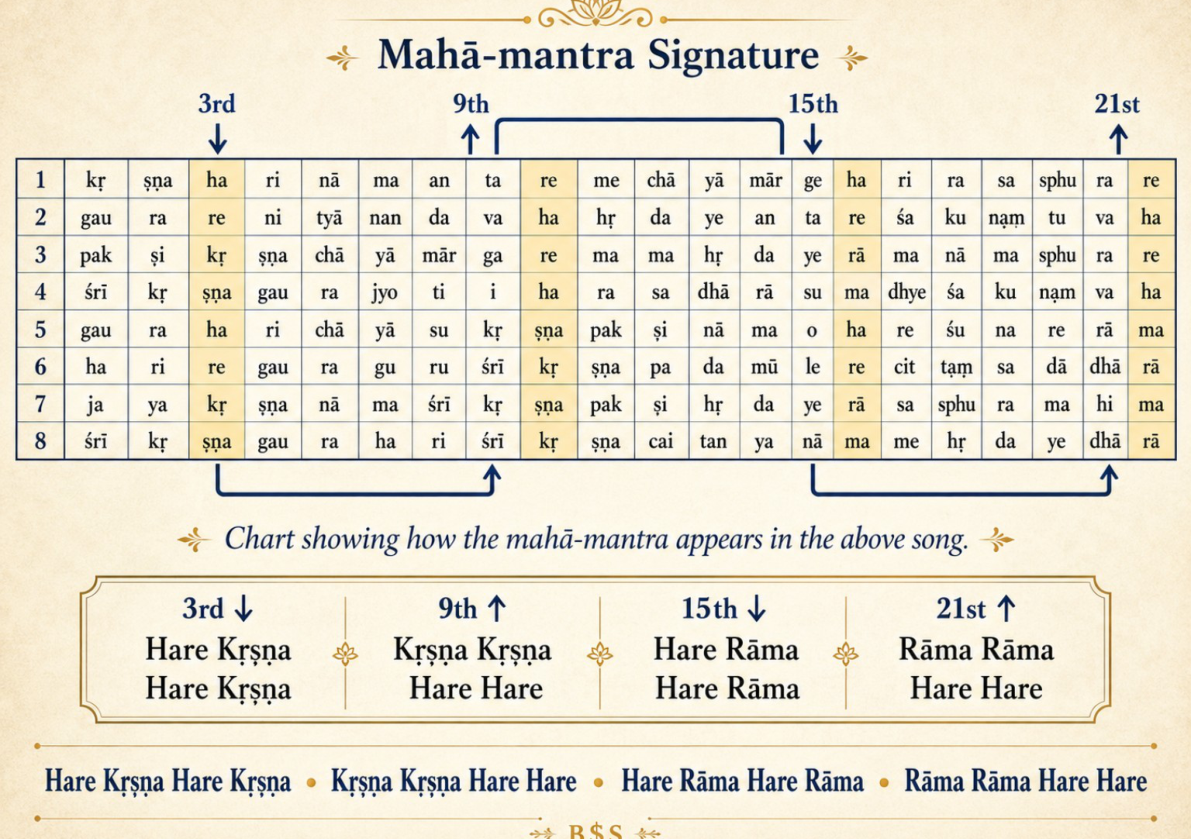
The supplied signature chart marks positions 3, 9, 15 and 21, with an alternating reading path. Presented here as it appears in the original booklet.

Original Mahā-mantra signature chart with highlighted positions 3, 9, 15 and 21 and alternating arrowsOpen the full-size chart ↗

THE PAÑCA-TATTVA PRAYER

Remembering the five.
Remembering the devotees.

jaya śrī-kṛṣṇa-caitanya
prabhu nityānanda
śrī-advaita gadādhara
śrīvāsādi-gaura-bhakta-vṛnda

The Pañca-tattva prayer is part of the devotional intention of the work. Gaura, Nityānanda, Advaita, Gadādhara and Śrīvāsa are remembered by name in movement V, and woven through the surrounding invocations.

Return to Remembrance ↗
06 / THE SCRIPTURAL FOUNDATION

ŚĀSTRA · THE GAUḌĪYA VAIṢṆAVA TEACHING

The refuge
of Kali-yuga.

Kṛṣṇapakṣi is offered in faith in the Holy Name. The conviction at its heart is received from the teachings of Śrī Caitanya Mahāprabhu and the Vaiṣṇava ācāryas: in Kali-yuga, Hari’s Name alone is the means of deliverance.

CAITANYA-CARITĀMṚTA · ĀDI 17.21

harer nāma harer nāma
harer nāmaiva kevalam
kalau nāsty eva nāsty eva
nāsty eva gatir anyathā
Sense in English: Chant Hari’s Name. In the age of Kali, that Name alone is the path; no alternative is given. The declaration is repeated threefold.
Read the verse and translation ↗
THE THREEFOLD EMPHASIS

Ādi 17.23 explains that the Name is repeated three times to make the instruction unmistakable. Ādi 17.24 explains kevala as excluding other processes; Ādi 17.25 explains the repeated denial of an alternative.

The artist’s threefold placing of the Mahā-mantra is offered as a poetic response to that emphasis.

THE ESSENCE OF THE MANTRAS

The Name is the dharma of the age.

Ādi 7.74 identifies chanting the Holy Name as Kali-yuga’s religious principle and the essence of the Vedic mantras. In this chapter, Caitanya recounts His spiritual master’s instruction.

Caitanya-caritāmṛta · Ādi 7.74 ↗
WHY THE NAME CAN DELIVER

Kṛṣṇa comes in the form of His Name.

Ādi 17.22 teaches that Kṛṣṇa is present as the Holy Name in this age, and that chanting brings direct association with Him and deliverance.

Caitanya-caritāmṛta · Ādi 17.22 ↗
THE CROSSING

One great gift in an ocean of faults.

Śukadeva Gosvāmī describes Kali-yuga’s extraordinary opportunity: chanting Kṛṣṇa’s Name frees a person from worldly bondage and leads to the spiritual destination. The following verse contrasts chanting in Kali with the practices of earlier ages.

THE SPIRIT OF CHANTING

Humility. Patience. Respect.

The third Śikṣāṣṭaka verse connects constant chanting with humility, tolerance, freedom from demands for personal honour, and respect for others. This is the disposition in which the declaration is carried.

Caitanya-caritāmṛta · Antya 20.21 ↗
THE MERCY OF THE NAME

The Lord places His power in His Names.

The second Śikṣāṣṭaka verse speaks of divine potencies bestowed in the Lord’s many Names and their accessibility beyond restrictions of time. Its speaker responds with longing for genuine attachment to chanting.

Caitanya-caritāmṛta · Antya 20.16 ↗

VOICES IN THE TRADITION

The teaching carried
through song and instruction.

Śrīla A. C. Bhaktivedanta Swami Prabhupāda

His lecture at New Vrindavan on 7 June 1969 begins with Ādi 17.21 and teaches the efficacy of participating in the chanting of the Holy Name. His explanations carry the same instruction into practical devotional life.

Read or hear the recorded lecture ↗

The Holy Name is the refuge.
This crossing-song is an offering of that Name.

Selected sources, checked 3 November 2026. English passages above are editorial summaries, not quotations of the published translations. Verse extracts and authorial devotional imagery are presented separately. Follow each reference for the source text, translation and available commentary.
The dark bird in midnight blue and weathered gold

07 / THE FRUIT OF BHAKTI

The song opens.
The heart follows.

A companion poem in sixteen movements. The craft within the chant. A devotional reading of love beyond reward.

Enter the English companion ↓
The recovered chant & source edition +

THE FRUIT OF BHAKTI / 01

The Fruit of Bhakti · The Black Bird of the Shadow-Path

BLUE $NAKE STUDIO · B$S · THE MOSS MAN

Complete literary companion edition · 3 November 2026

Midnight blue. Weathered gold. A beautiful nightmare learning to sing.

This edition preserves the recovered chant and develops a new English companion poem and interpretive breakdown. The English companion is an original expansion, not a literal Sanskrit translation. The devotional reading speaks from within the Gauḍīya Vaiṣṇava understanding of Kṛṣṇa-prema: love for Kṛṣṇa as the fulfilment of devotion.

THE FRUIT OF BHAKTI / 02

The threshold

Before the bird becomes an omen, it is a bird.

Before the name becomes a cipher, it is a call.

And before the singer knows what he has hidden in the song, his breath has already carried it across.

Kṛṣṇapakṣi begins in the dark because longing often does. A black wing crosses the half-lit road. Somewhere within it, gold. Somewhere beneath the gold, a name. The listener follows the bird, discovers the pattern, enters the chant—and gradually encounters a question more difficult than any code:

What remains of devotion when there is nothing left to win?

The work ripens around that question. Its fruit is the wish to love and serve the Beloved, even after reward has lost its power to persuade.

THE FRUIT OF BHAKTI / 03

I · The recovered opening song

Original wording preserved, including its hybrid devotional chant forms.

Hareṣa-chāyā-mārge antare bhāvaha,
Kṛṣṇapakṣi-śakune habe pāra —
Hare-nātha antar-jyoti naḥ pracodaya,
Kṛṣṇa-gaura uha sāra.

Kṛṣṇa-pakṣiṇaḥ svapnaṃ paśyanti punaḥ punaḥ,
Kṛṣṇa-pakṣā mārga-darśakāḥ —
Hare-jñāna udeti yāvat svapnaṃ hṛdi sphure,
Hare-dhvani vahati śakunaḥ.

Hare-gaura-chāyā nitya-vāyau liyate,
Rāma-rase advaita-sparśaḥ —
Hare-gadādhara-dhvaniḥ hṛdaye śrūyate,
Rāma-jyotiḥ śrīvāsa-pakṣaḥ.

Rāma-nāde guru-nādaḥ sphurati,
Rāma-hāre prema ujjvāla —
Hareṇa pareṇa dhareṇa hara,
Hare kṛṣṇa hṛdaya-vihāra.

THE FRUIT OF BHAKTI / 04

II · The name made audible

Hare Kṛṣṇa Hare Kṛṣṇa,
Kṛṣṇa Kṛṣṇa Hare Hare.
Hare Rāma Hare Rāma,
Rāma Rāma Hare Hare.

THE FRUIT OF BHAKTI / 05

III · The Pañca-tattva bridge

Gauraṃ nityānandaṃ advaitaṃ smarāmi,
Gadādharaṃ śrīvāsaṃ ca —
Antar-hṛdaye bhāvayāmi sadā,
Kṛṣṇapakṣiḥ nayatu mām.

Devotional sense: I remember Gaura, Nityānanda, Advaita, Gadādhara and Śrīvāsa; I hold them within the heart. May Kṛṣṇapakṣi lead me.

This is the work’s own invocation of the Pañca-tattva, rather than a reproduction of the standard Pañca-tattva mantra.

THE FRUIT OF BHAKTI / 06

IV · The eightfold chant

1. Kṛṣṇa-hari-nāma antare me, chāyā-mārge hari-rasa sphura re —

2. Gaura re nityānanda-vaha, hṛdaye antare śakunaṃ tu vaha.

3. Pakṣi-kṛṣṇa chāyā-mārga re, mama hṛdaye rāma-nāma sphura re —

4. Śrī-kṛṣṇa gaura-jyoti iha, rasa-dhārāsu madhye śakunaṃ vaha.

5. Gaura-hari chāyāsu kṛṣṇapakṣi-nāma, o hare śuna re rāma kṛṣṇapakṣi —

6. Hari re gaura-guru śrī-kṛṣṇa, pada-mūle re cittaṃ sadā dhārā.

7. Jaya kṛṣṇa-nāma śrī-kṛṣṇapakṣi, hṛdaye rāsa sphura mahima —

8. Śrī-kṛṣṇa-gaura-hari śrī-kṛṣṇa, caitanya-nāma me hṛdaye dhārā.

THE FRUIT OF BHAKTI / 07

V · The crossing: recovered closing verses

Kṛṣṇāḥ pakṣiṇaḥ svapnanti, kṛṣṇān balambalān iva;
Teṣāṃ svapne punaḥ sphuranti, kṛṣṇāḥ pakṣiṇa eva hi.

He narāḥ, paśyata pakṣaṃ saṃhṛtam;
Śakunaḥ draṣṭāraṃ svapnati, draṣṭā śakunaṃ svapnati;
Bhayaṃ ca dhārayati rūpam eka-pārśvasya cakrasya.

He bālakāḥ, ākarṣata, ākarṣata — agninā, phenena ca;
Imaṃ nāvaṃ nayāmaḥ asurasya gṛhāt param.

He kanyāḥ, ākarṣata, ākarṣata — stanitena, gagane ca;
Dvārāṇi bhañjāmaḥ yatra devadūtāḥ nīlyante.

Aho kṛṣṇāḥ pakṣiṇaḥ! Aho kṛṣṇa-gaṇaḥ!
Svapnata kṛṣṇān pakṣān! Rājñām api pārataḥ tarata!

Yarra-kardamāt ārabhya — nyāya-ghaṇṭā-paryantam —
Svargaṃ gṛhṇīmaḥ, narakaṃ gṛhṇīmaḥ.

Kaḥ sa śabdaḥ? Purātanaḥ garjaneśvaraḥ garjati!
Kasya vāyu-viplavaḥ? Airitrāṇi yeṣāṃ santi, teṣām.

Tarata, tarata, kṛṣṇaṃ tarata!
Na devaḥ, na śmaśānam, na punar-āvṛttiḥ.

Kṛṣṇapakṣi — tarata, tarata, jvālāṃ tarata!
Svargaś ca narakaś ca — asmākaṃ nāma jānītaḥ.

THE FRUIT OF BHAKTI / 08

VI · The fruit: an original English companion in sixteen movements

1 · The flute calls

A note came walking through the dark.
It had no shoes. It left no mark.
The night leaned close to hear it pass.
The stars lay trembling in the grass.

I asked the sound what it would bring.
It took my question. Let me sing.

2 · The listener

I knew the roads that led to gain.
I knew the prayers that bargained pain.
But this small music asked of me
a heart with room for someone free.

Someone no wish could make my own.
Someone whose name made less alone.

3 · The black wing

Black bird, black bird, cross the blue;
carry what I cannot prove.
Gold beneath your weathered wing,
teach my frightened mouth to sing.

4 · The first concealment

At every doorway stood a name.
I walked inside. I missed the same
soft calling at the opening breath—
a little life beneath the text.

I read for what the song could give.
The song was teaching me to live.

5 · The golden current

Then gold came running down the rain,
through all the places I called stain.
It found no throne beneath my ribs.
It made a room of what there is.

No flawless vessel. Just this clay.
The guest came in and chose to stay.

6 · The bridge

Five names beside the river stood;
the water gathered where it could.
They placed a song upon the tide.
I heard another voice beside

my solitary, weathered cry.
The crossing grew a we and I.

7 · The open name

Hare Kṛṣṇa—breath and bone.
Hare Kṛṣṇa—less alone.
Kṛṣṇa Kṛṣṇa—let it be.
Hare Hare—carry me.

Hare Rāma—river wide.
Hare Rāma—turn the tide.
Rāma Rāma—through the night.
Hare Hare—keep the light.

8 · The hidden field

Down through the furrow. Up through the grain.
Down through the syllables. Up through the rain.
Under the sentence, patiently sown,
the name kept growing its way to my own.

I thought I had found what the maker concealed.
Then heard what was calling through all of the field.

9 · The cowherd

The hand that held my sky in place
was resting on a small calf’s face.
The greatness I had dressed in gold
had found a trembling thing to hold.

I stood there with my grand request.
A breathing creature leaned and rested.

10 · The unbinding

I brought a rope to measure You.
The morning widened. So did blue.
Then love, with flour upon its hands,
did what no measuring understands.

You stayed. The knot was gently tied.
The sky stood laughing at Your side.

11 · The serpent

Time raised its many-headed hood.
I counted all the years I could.
The song passed softly through its teeth.
I felt the earth move underneath.

Let every borrowed kingdom fall.
Keep me attentive to Your call.

12 · The distance

Tonight the bank is bare of feet.
The flute is quiet. The dark is deep.
I set no trap of prayer for You.
I leave the little lamp in view.

Let love grow honest in this room.
Let care keep working through the gloom.

13 · The offering

Take all the crowns I meant to earn.
Leave me a little work to learn.
A cup to wash. A life to feed.
A chance to notice someone’s need.

And in the quiet after praise,
let me be useful all my days.

14 · The crossing

From Yarra mud to weathered pier,
we take the oars. We carry fear.
Through fire and foam, through thunder’s seam,
we row the people from the dream.

The black bird turns above the spray.
We make each other room to stay.

15 · The fruit

I came to take the fruit away.
I stayed to tend the tree today.
Its sweetness moved from hand to hand.
I tasted what I could not command.

Beloved, let Your gladness be
a growing, living wish in me.

16 · The song remains

Black bird, black bird, fold your wing.
Leave me with the name you sing.
Gold beneath the midnight blue,
let my hands remember You.

The river carries out the flame.
The morning opens with Your name.

THE FRUIT OF BHAKTI / 09

VII · How the work opens

The title carries the crossing

In this artwork, Kṛṣṇapakṣi holds together the dark bird and the bird of Kṛṣṇa. That is its artistic double reading. A black cockatoo can remain recognisably a bird of the local coast while also carrying the devotional name through the song. The connection is poetic; it does not claim an inherited local sacred identity for the character.

The shadow-path gives the bird somewhere meaningful to fly. Devotion enters an unfinished life, a place with grief, dirt, weather, contradiction. The name is carried through that life. In the companion poem, the gold lives underneath the wing: discovered through movement, glimpsed rather than displayed.

Three encounters with one mantra

There are three presentations of the Mahā-mantra: a pattern of opening name-elements, the explicit chant, and a second concealment inside the syllable table. There are two cipher devices, not three separate ciphers.

EncounterMechanismExperience
Opening songSixteen initial name-elements follow the sixteen-word Mahā-mantra sequenceThe name stands at each threshold
Visible Mahā-mantraThe complete mantra is sung directlyDiscovery becomes participation
Eightfold chantSelected syllable columns assemble the mantraThe name is encountered within the structure

The opening pattern needs an exact description. Some lines begin with compounds or inflected forms, including Hareṣa and Hareṇa. Recovering Hare from those openings uses the intended name-element; it is not always a literal extraction of a complete standalone first word.

That precision protects the interesting part: the same devotional address occurs at the beginning, on the surface, and inside the work. A listener can encounter it before knowing how to look.

The rectangle makes reading a movement

The recovered table has eight rows and twenty-five columns. Short rows are padded with empty cells. Its cells are the edition’s chosen chant units; the division is not a claim about rigorous classical Sanskrit syllabification.

ColumnDirectionExtracted units
3Downha · re · kṛ · ṣṇa · ha · re · kṛ · ṣṇa
9Upkṛ · ṣṇa · kṛ · ṣṇa · ha · re · ha · re
15Downha · re · rā · ma · ha · re · rā · ma
21Uprā · ma · rā · ma · ha · re · ha · re

The reader follows a winding route across a field of sound. The direction changes, yet the devotional address survives. As interpretation, this gives the work a beautiful correspondence between form and subject: a life changes course while remembrance can continue through it.

The cipher is a constructed feature of the poem. Its existence demonstrates craft; its spiritual meaning belongs to the devotional reading.

Gaura turns gold into generosity

Within the Gauḍīya tradition, Caitanya’s golden appearance is associated with the merciful gift of elevated devotional love. Caitanya-caritāmṛta Ādi 1.4 supplies the theological anchor for this reading.

That makes gold much more useful than ornament. Here it can signify love becoming available, flowing toward the singer. The image becomes moving when the gift reaches the imperfect vessel: “It made a room of what there is.”

The Pañca-tattva bridge also changes the social shape of the song. The solitary seeker remembers named persons and enters a tradition of relationship. The boat acquires company.

The cowherd makes infinity intimate

The calf is essential. It gives the vastness a living creature to care for. With it, the artwork can move from cosmic scale into the warmth of a hand, an animal’s breath, a shared stillness.

The Yaśodā episode deepens that movement. In Bhāgavata 10.9.18, Kṛṣṇa sees His mother’s exhaustion and mercifully allows Himself to be bound. The poem draws on that episode to imagine an infinity that freely answers love.

This is the most effective place to suggest prema’s greatness. A spectacle of domination would leave the viewer impressed by power. This small domestic scene gives the viewer an encounter with tenderness capable of moving the powerful.

Separation changes the question

The quiet flute creates space for devotion to disclose its motive. The singer once wanted a result; now the singer must decide what care looks like without immediate consolation.

In the companion poem, the answer is a lamp and useful hands. Longing takes a practical form. This is an artistic treatment of devotional separation, not a suggestion that human mistreatment should be accepted as sacred.

The person continues to live, care, and act. The song’s maturity appears in those ordinary verbs.

The fruit is a change in desire

The central theological distinction comes from Caitanya-caritāmṛta Ādi 4.165–166: kāma directs desire toward one’s own enjoyment; prema directs it toward Kṛṣṇa’s happiness. The companion translates that distinction into the movement from taking fruit to tending a tree.

“Beloved, let Your gladness be / a growing, living wish in me.”

That is where the work hints most clearly at the supremacy of Kṛṣṇa-prema bhakti within its own devotional horizon. The seeker’s finest attainment becomes the capacity to love. Even spiritual achievement ceases to be a possession held up for admiration.

Bhāgavata 1.2.6 describes the fulfilling character of devotion through freedom from ulterior motive and continuity. The poem makes those qualities felt through the name persisting across its changing forms, and through service continuing after applause has ended.

The final crossing returns love to the world

The recovered closing current is fierce: demons, gates, heaven, hell, kings, oars, fire. Its refusal gives the work a strong B$S voice. It also creates a real tension with devotional surrender, especially in the line rendered in the earlier edition as “No god, no grave, no turning back.”

The new companion keeps that original visible and gives the crossing a different culmination. The singer takes the oars to help others cross. Defiance has ripened into service. Courage becomes capable of tenderness.

This brings the river back to Frankston and the Yarra without treating local place as decorative proof of spiritual authority. The local world is where the devotion has work to do.

THE FRUIT OF BHAKTI / 10

VIII · The quiet claim

The bird can dazzle. The code can astonish. The imagery can open like a beautiful nightmare in midnight blue and weathered gold.

But the work becomes more moving when its final achievement is small enough to hold: a lamp left burning, a cup washed, an animal sheltered, a boat steadied, a name remembered without an audience.

Its devotion has travelled from fascination to relationship. Its language has travelled from concealment to song. Its courage has travelled from overthrowing a kingdom to caring for a life.

That is the greatness the piece can quietly claim for prema: within its devotional vision, love reaches a fulfilment that acquisition cannot provide. It wishes for the happiness of the Beloved, and learns to make that wish active.

I came to take the fruit away.
I stayed to tend the tree today.

Recovered chant source: Krsnapaksi_Chant_Hidden_Mantra_BS_FIXED.pdf, thirteen pages, saved 2 July 2026. The sixteen-movement English companion and interpretive commentary are original expansions of that chant and the fruit-of-bhakti direction.

Editorial and source note

Recovered source: Krsnapaksi_Chant_Hidden_Mantra_BS_FIXED.pdf, thirteen pages, saved 2 July 2026. The newer file titled Kṛṣṇapakṣi — The Fruit of Bhakti.txt could not be opened in this session; this edition does not claim to reproduce its unavailable text. It continues the recovered chant and the established fruit-of-bhakti direction with newly written English poetry and commentary.

The source chant mixes Sanskrit vocabulary with vernacular and freely formed chant language. Its evocative English renderings should not be represented as audited, word-for-word classical Sanskrit translations. The title’s resonances and the black bird’s role are artistic interpretations. The Sanskrit alphabet-order pangram discussed in the previous conversation is a separate work; no formal equivalence with this chant is asserted here.

The theological framing follows the Gauḍīya Vaiṣṇava tradition. References below distinguish that grounding from the new artwork’s metaphors and claims of artistic merit.

Faster than lightning. Slower than moss.
B$S · Blue $nake Studio · Frankston

08 / KEEP THE WORK
Kṛṣṇapakṣi reader edition cover: navy and gold

THE COMPLETE READER EDITION

A work to return to.

All sixteen movements. Original Sanskrit-style chant, devotional English reading, word-for-word gloss, and the Mahā-mantra signature chart.

Open the booklet ↗Download PDF · 36 pagesRead the English companion & commentary ↗
A note on the text

The reader edition describes its language as Sanskrit-style devotional verse, retaining sung forms alongside Sanskrit. The chant and English reading on this page reproduce that edition; the Pañca-tattva prayer is displayed separately as the devotional prayer identified by the artist.

TOM MOSS · THE MOSS MAN

Whatever beauty I have brought to it,
I place in service.

KṚṢṆAPAKṢI

Return to the beginning ↑